|
How Francophile were early modern English playwrights? (continued)
Case studies
The entire corpus of Christopher Marlowe's plays has been closely looked at. This provides us with a good opportunity to carry out a case study.
Verbal exchange in Marlowe is also the privileged medium for the vast majority of allusions (98.8%) - the dramatist does not differ in this from the general figures highlighted previously. Moreover, French characters (either historical or fictional) are the most common subjects of these allusions (81%). It is noteworthy nonetheless that Marlowe uses fewer French words in his plays than the majority of the dramatists we have examined (only 3.8%). France is mainly present politically (56.6%), historically (53.6%), geographically (22.2%) or as a nation (21.5%). (Note: added up, these different figures will not come down to a 100%, as a number of allusions in the database were related to several domains). Ideas and beliefs represent 10% of the allusions - a figure which sets Marlowe well above the general average of 2.8% . Let's now take a look at the tone of Marlowe's allusions:
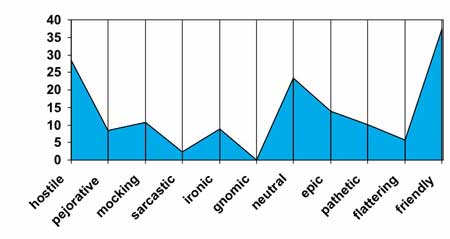
Graph of the various tones recorded in Christopher Marlowe's plays (figures in%)
|
We can notice that neutral allusions are also high on this graph (cf. peak in the middle), but that the extremes on both sides clearly dominate this time. Nevertheless, a number of negative tonalities remain fairly low - sarcasm in particular. Friendly allusions dominate overall. They even tower above neutral allusions - while the other positive tonalities remain relatively high, except for flattery.
In sum , Marlowe's view of France is often through the extremes, even if positive opinions win by a short lead. Neutrality remains also a not so negligible feature of Marlowe's representation of France and the French.
Let's move on now to another case study, Thomas Middleton's plays - a corpus which has likewise been studied entirely:
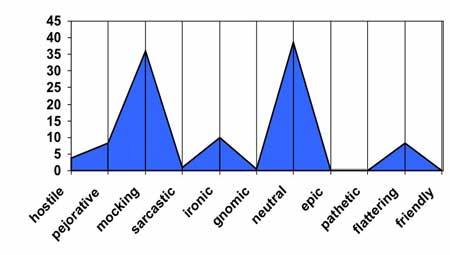
Graph of the various tones recorded in Thomas Middleton's plays (figures in%)
|
Looking at the above graph, it is easy to notice the differences with Marlowe's plays. There is very little hostility in Middleton's dramatic works, but a lot of mockery and an almost equal amount of neutrality. Friendship towards France is clearly not a feature of his plays. Middleton is thus a very special case. Furthermore, it is interesting to note that Middleton's allusions are primarily conveyed through French words and the French language (35%), then through persons (27%), things (20%) and also locations (10%). In total opposition to the figures found for Marlowe, French ideas and beliefs are not represented at all (0%), politics only reaches 0.4% and history does not fare much better (3%).
Comparative approach
Let's now compare the tonalities of all the plays in the database with those of Marlowe and Middleton:
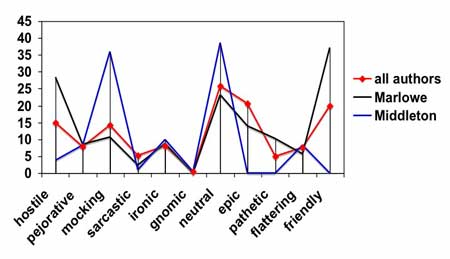
Comparative graph of all the tonalities
|
A quick look at the above graph reveals that Middleton stands out quite clearly. The blue line is well above the red which represents the average. Marlowe (cf. black line) stays generally closer to average figures - apart from his extremes which situate him well above Middleton and the other dramatists.
|